
You can’t “wash out” bleach discoloration the way you can a regular stain, since bleach removes color from carpet fibers. The solution to the problem will depend on whether the bleach is still wet on the carpet or has been washed out, leaving a pale spot. To deal with fresh bleach spills, blot up as much as you can and then rinse the spot thoroughly with cool water to remove any remaining bleach. If the fibers have already been bleached white or lightened, your only options are to either re-dye the fibers using an appropriate carpet dye or touch-up marker or to cut out the damaged section and replace it with a piece of matching carpet from a closet or remnant.
Why Bleach Damage Isn’t a Regular Carpet Stain
Unlike wine, coffee, or mud, bleach damage isn’t a surface stain that can be lifted with a cleaner and blotter. Bleach is a chemical oxidizer that strips dye molecules from carpet fibers, leaving them permanently devoid of pigment. There is no “cleaning” solution to undo this, since the dye has been physically removed from the fibers themselves.
This means that your approach to removing bleach damage will depend on how far along the process is:
Bleach is still wet or has just been spilled: Your goal is damage control and neutralization to prevent additional staining.
Bleach has already dried and lightened the carpet: You will need to repair the spot by re-coloring it or patching the fibers.
Important: Never scrub a fresh bleach spill or add water aggressively — this can spread the bleach into a wider area and push it deeper into the carpet pad, making the eventual damage larger.
Step 1: Act Immediately If the Bleach Is Still Wet
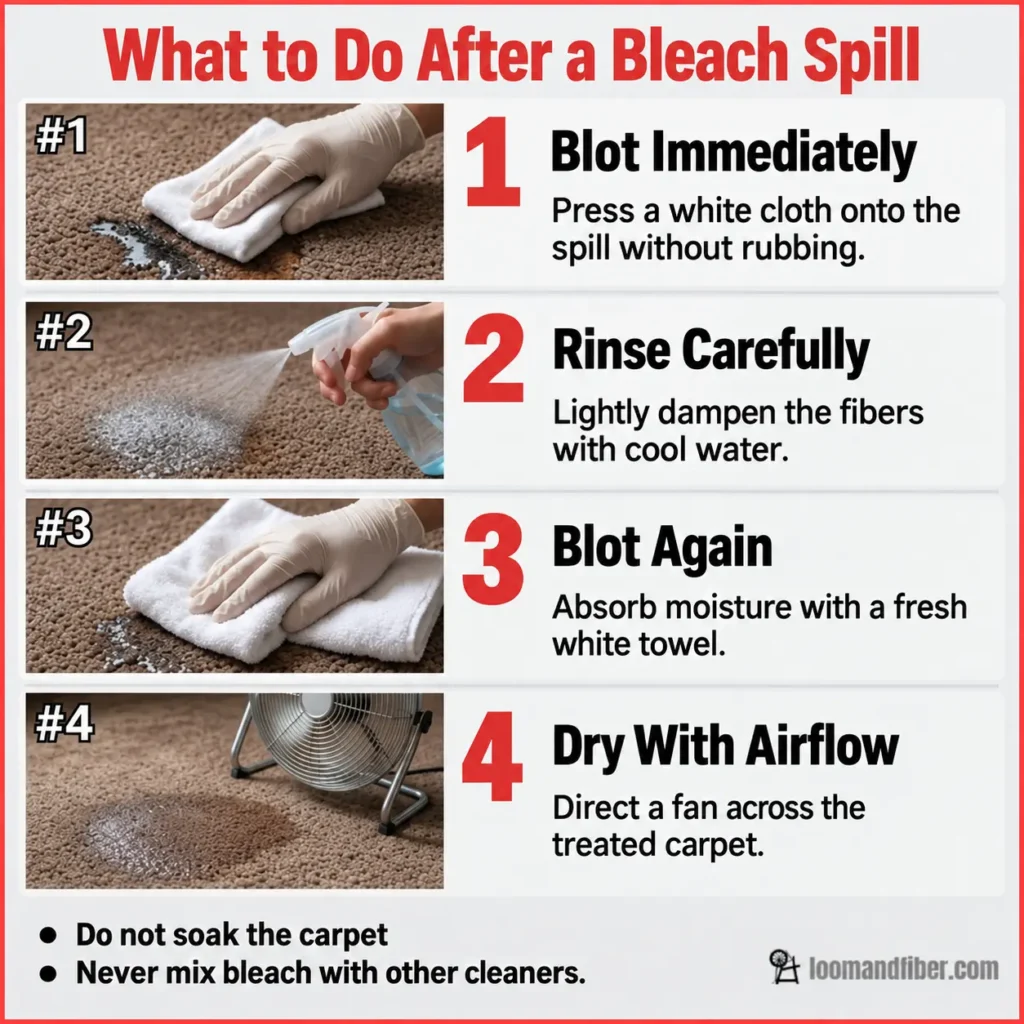
- Blot, don’t wipe: Using white paper towels or a clean white cloth, blot the liquid bleach off the fibers to remove as much of it as possible. Wiping spreads the liquid into a larger stain.
- Rinse with cool water: After blotting up the excess, sponge the spot with cool (not hot) water and blot again. Hot water accelerates the oxidation process, causing the fibers to bleach faster. Repeat this 2-3 times total, blotting and rinsing until you’ve diluted most of the bleach.
- Neutralize the bleach: Mix 1 teaspoon of sodium thiosulfate or 1 tablespoon of hydrogen peroxide based reducing agent with 1 cup of water. Sponge the affected area with the solution, let it sit for 5 minutes, then blot the fibers dry. This will chemically stop the oxidation process before it moves deeper into the fibers.
- Dry the area completely: Lay a stack of dry towels over the spot and place a book or a heavy object on top to weigh them down for a few hours, replacing wet towels with dry ones as needed. You can also use a fan or leave the window open to speed up the process. Drying is essential to prevent further wicking.
Why this matters;
The sooner you blot, rinse, and neutralize a fresh bleach spot, the less chance there is for it to leave a noticeable white spot. Even waiting 10-15 minutes longer can drastically increase the size of the stained area.
Supplies You’ll Need
| For fresh spills | For already-discolored spots |
|---|---|
| White paper towels or white cloths | Carpet dye kit or fabric dye matched to carpet color |
| Cool water, spray bottle | Cotton swabs or small artist’s brush |
| Sodium thiosulfate or bleach neutralizer | Carpet touch-up marker (for small spots) |
| Clean dry towels, weight/book | Sharp utility knife (for patching) |
| Fan (optional, speeds drying) | Matching carpet remnant or scrap from a closet |
| Carpet seam tape or double-sided carpet tape |
Step 2: Prevent Further Staining or Discoloration
If you’ve found an already set bleach spot, there is no need to do any immediate treatment, since the oxidation process has already completed. However, if the spot still smells a little like chlorine or feels damp, you can use the neutralizing solution from step 1 to ensure that the pad doesn’t contain any bleach left that could light the carpet fibers.
Step 3: Repair the Discoloration (Not Remove, Only Conceal)
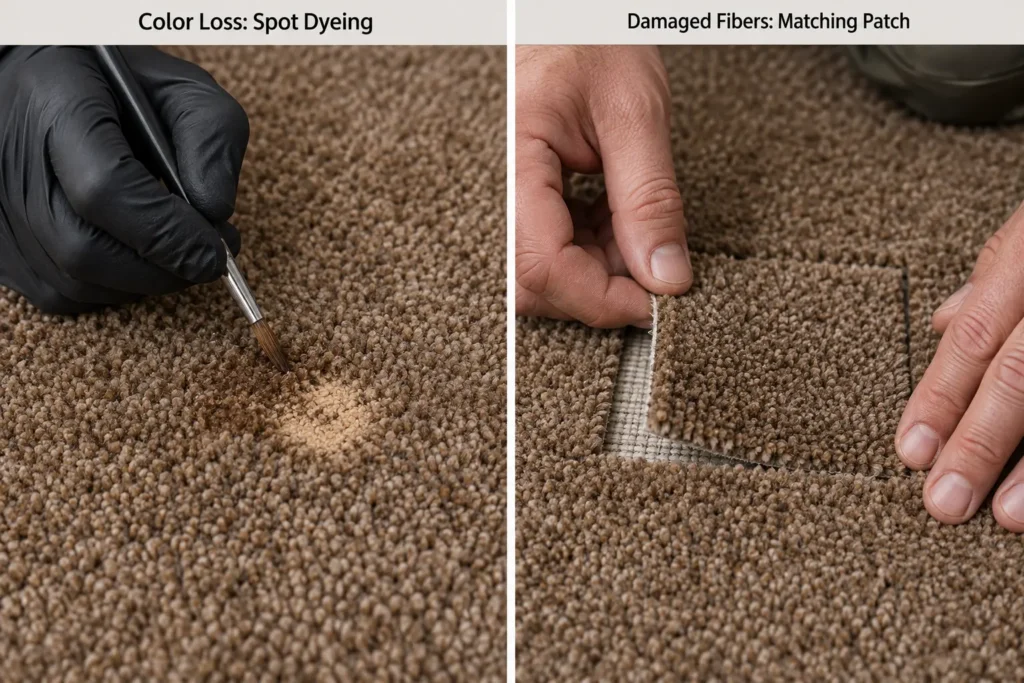
Option A: Carpet touch-up marker or fabric dye pen (best for small spots, under 1 inch)
- Buy a carpet touch-up marker or permanent fabric marker in a shade that matches your carpet. Carpet retailers and home improvement stores will have specific bleach/spot removers for pet stains or bleach spots.
- Test the touch-up color on a small, hidden section of the carpet (such as the inside of a closet) to make sure it blends well.
- Color the individual white fibers, working from the outside of the spot in and blending them with a cotton swab while the solution is still wet.
- Let the solution dry completely (usually 30-60 minutes) and then walk on the spot normally.
Option B: Carpet dye kit (best for large spots or multiple spots)
- Get a carpet dye kit that’s appropriate for the type of fibers you have (nylon and wool absorb dyes differently than polyester or olefin). Many kits specify if they’re for polyester/olefin (the latter being especially resistant to dyed carpet repair).
- Follow the manufacturer’s instructions to mix the dye and test the solution on a hidden piece of the same carpet.
- Use the kit’s applicator (usually a small brush) to apply thin coats of dye (don’t apply too dark of a color at once) and blot away any excess dye.
- Allow the dye to cure for the recommended time (often 24 hours) before vacuuming or walking on the spot.
Option C: Contact a professional carpet dye technician
For large bleach spots or to color-match a spot evenly to the rest of the carpet, a professional carpet re-dyeing service can color a spot so that it appears to be part of the original carpet, for a much lower price than replacing an entire carpet. This is especially valuable on large spots or in high-traffic areas, or on an expensive carpet.
Read More>> How to Disinfect Carpet?
Step 4: Patch the Carpet (If the Fibers Themselves were Damaged by Bleach)
Bleach can damage the fibers of some carpets, causing them to fray or become brittle. If so, simply re-coloring the fibers won’t help; you’ll need to cut out the entire spot and replace the fibers.
- Find matching carpet
- If you have any carpet remnants from installation, or pieces in the closet or under the couch that could be cut out to replace the damaged spot, do so. Otherwise, ask a flooring store if they can order a small swatch from the same brand and color as your carpet.
- Cut out the damaged section
- Using a sharp utility knife and a straight edge (such as the top of a jar or a piece of cardboard), cut a shape out of the carpet around the bleach spot and cut out a matching shape from your carpet replacement.
- Set the patch
- Place a carpet seam tape (with the sticky side facing up) underneath the hole in the carpet, then press the replacement patch into place with the right side facing up, aligning the fibers. Let the tape set for a few minutes.
- Blend the Seam
- Gently rake or brush the fibers on the patch to blend them with the rest of the carpet.
Tip
If you don’t have any matching carpet remnants, many home or flooring stores can order a small swatch if you know the brand and color of your carpet (check under a baseboard or in a closet for a leftover tag.).
How to Prevent Bleach Damage on Carpet
- Store bleach cleaners in a lidded container and only open them over a hard floor or sink, not on the carpet itself
- Use bleach-free or “carpet safe” disinfectants when working near carpeted areas
- Keep a container of bleach neutralizer or hydrogen peroxide handy in case of a spill
- Use a towel or drop cloth to protect the carpet when cleaning tile, grout, or the bathroom
- Store bleach bottles upright on a low shelf instead of walking around with them
Read more>> How to Deodorize Carpet?
FAQs
No. Baking soda and vinegar are useful for surface stains but have little effect on deep discoloration. Bleach removes the dye molecules from the fibers, and baking soda or vinegar aren’t able to put the dye back.
No. Once the fibers have lost their dye, they will remain that color until they can be dyed again. This could mean dyed carpet repair, using a carpet touch-up marker, or patching the fibers if they’ve been irreparably damaged.
Hydrogen peroxide is great for neutralizing any remaining bleach residue, but it won’t actually remove the discoloration caused by the bleach. It’s an essential step in preventing further staining, but not a repair method.
It can begin to bleach within 1-2 minutes of contact, and the damage can become permanent within 10-15 minutes.
You can usually touch up a small spot (under 1 inch) yourself, or use a carpet touch-up marker. Larger spots, in high-traffic areas, or on an expensive carpet should be professionally dyed to avoid a noticeable color difference.
Yes, patching is always an option if the fibers have been irreparably damaged or if you have a piece of matching carpet to use as a replacement.