
Algodón cotton fabric is just cotton fabric with its Spanish name. Spanish: algodón literally means cotton. In this way, algodon cotton is not another sort of material, but merely cotton fibre or cloth, which is marked in Spanish. This is the name that is employed in Spain and Latin America in relation to cotton fabrics. Algodon cotton fabric = 100% cotton fabric (the term is derived from Arabic al-qutn). You will often find that the products manufactured in Spanish-speaking markets are labeled as 100% algodon.
What Does “Algodón” Mean?
The Spanish name of cotton is algodon. It is derived out of the Arabic al-qutun. Algodon is used in daily life to refer to the same natural cotton fiber (and cloth) as the English cotton. To illustrate this, a garment with the label 100% algodón just refers to 100% cotton. In the Spanish speaking world (Spain, Mexico, Argentina, etc.), algodón is employed in all cultures, instead of the English word. The fiber – algodón and the cottons are identical. The distinction is purely linguistic: the English say cotton, Spanish say algodon.
What Is Algodón Cotton Fabric?
The algodon cotton is 100% cotton fiber (of the cotton plant) sold under its Spanish name. It is a natural fabric that is composed of the fluffy fibers (lint) of cotton bolls. As it is practiced, algodon cotton fabric only refers to any type of cotton cloth that is woven or knitted and being sold in Spanish-speaking markets. It is not some special mixture or synthetic that of plain cotton. In textile labels in Spanish, the word algodon is used in the description and tags of the product, rather than cotton. When you purchase a sheet or T-shirt at Mexico or Spain that says algodon, you are purchasing ordinary cotton. To conclude, algodon cotton fabric is the type of cotton fabric, which is valued because of its softness and breathability.
A Brief History of Algodón Cotton
The history of cotton is ancient worldwide. The earliest fabricated cotton took place about 3000 BCE in South Asia, Indus Valley. Even earlier evidence (c. 6000 BCE) was discovered in Peru and in 2500 BCE cotton was woven in China and Egypt. In Mexico, archaeologists discovered cotton dating to circa 5500 BCE. Therefore, cotton (algodón) was cultivated in Asia and the Americas way before modernity.
Cotton was brought to the world after Columbus voyageries. In 1492, Columbus observed the presence of cotton in the Caribbean, and by 1500 cotton was familiar all over the world. The adoption of cotton crops and textile production was embraced in Spain and its colonies. As an illustration, Spanish California had cotton plantations in the 1770s and the colonial era of Mexico had cotton as a significant crop. In 19th-century Spain (particularly Catalonia) cotton mills also expanded with the spread of the Industrial Revolution.
Nowadays cotton (algodon) is cultivated on a large scale in India, China, US, Brazil, and other countries and is sold all over the world. Cotton is also grown in Spain and Latin America, and the use of traditional textile is common in the usage of algodon. So the word algodon has a rich history.
How Algodón Cotton Fabric Is Made
There are a few major steps that cotton fabric undergoes, field to cloth. The raw plant fiber is converted into finished fabric in each of the following steps:
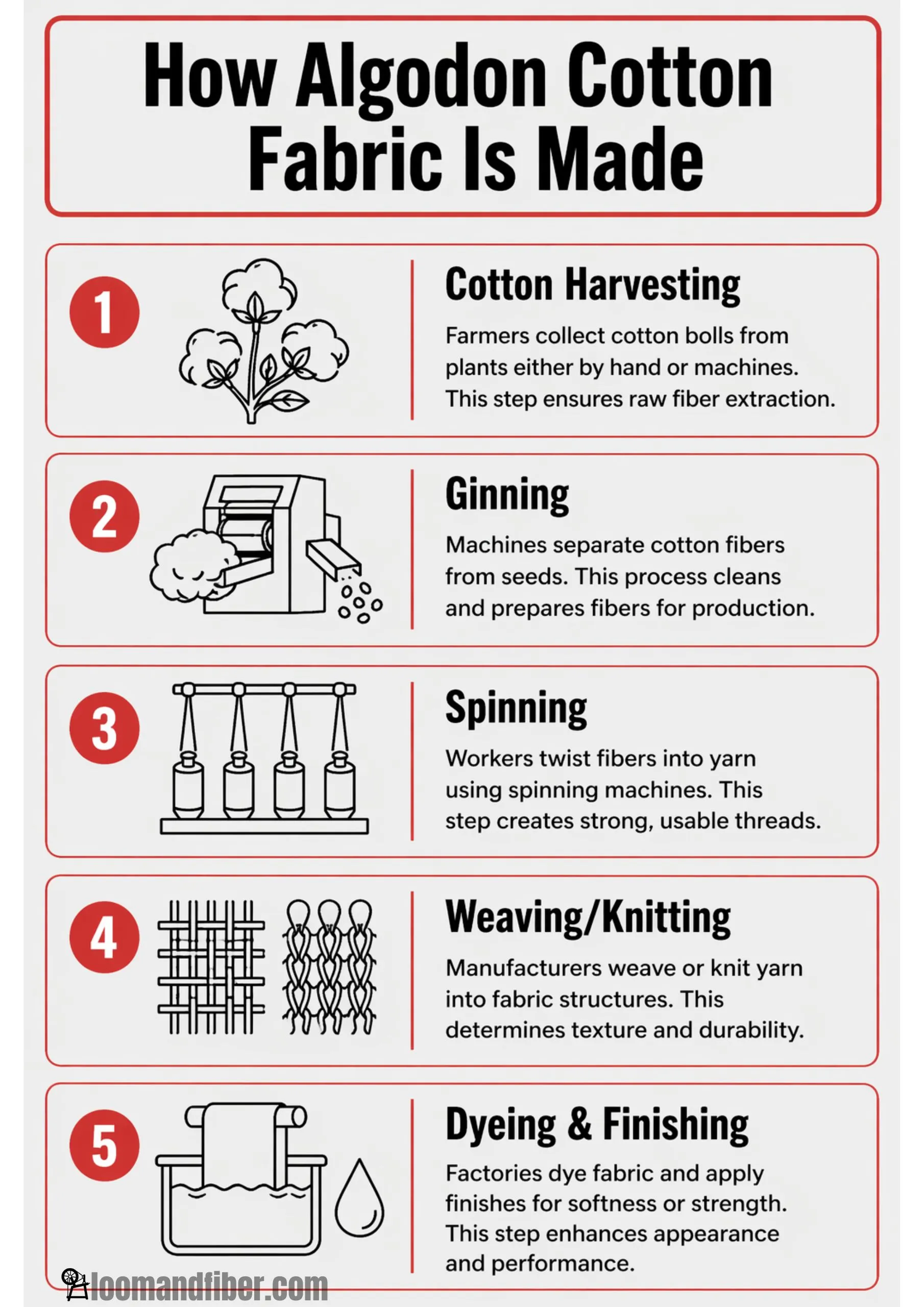
Cotton Harvesting
When cotton bolls are ripe farmers harvest them by picking or machine-harvesting them. The fluffy fiber is revealed by bursting the bolls. Cotton used to be hand-picked; in modern farms, mechanical pickers are in use.
Ginning
Cotton fiber should be gin-ned after harvesting. A cotton gin machine is a machine that takes out the seeds and debris of the raw cotton lint. Ginning washes and sorts the fibers and forms lint that is pressed into bales to be milled.
Spinning
The cotton lint is then rolled into a yarn which is clean. This entails carding and combing the fibers to form the fibers in line, and pulling and twisting the fibers into long continuous strands of yarn. Spinning converts the loose cotton into soft yarn.
Weaving or Knitting
The yarn is knitted or woven into cloth. The yarns are woven on a loom to form cloth (common to cotton fabric), and knitted in loops on a yarn (common to T-shirts). This transforms yarn into pieces of cloth.
Dyeing & Finishing
Lastly, the cloth is woven and dyed. Fabrics can be washed in bleach or dye. Then finishing processes (such as mercerizing or sanforizing) enhance softness, strength or wrinkle resistance. The final product is finished cotton fabric (algodon) that can be sewn into clothes or bedding.
The end result of every stage is the soft, breathable cotton cloth that we refer to as algodon in Spanish.
Key Characteristics of Algodón Cotton Fabric
- Softness: Cotton (algodón) is soft by nature and skin friendly. It is said to be comfortable to wear on a daily basis.
- Breathability: Algodon is very breathable. It allows air to pass through and it absorbs moisture, making you cool in hot weather.
- Absorbency: Cotton is highly absorbent – it has the ability to absorb a lot of water (usually >20% of its weight). It is the reason why towels, bathrobes and summer clothes are frequently made of cotton.
- Durability: Cotton fibers are tough when closely spinned. Cotton cloth of high quality can be extremely strong and can withstand frequent washings.
- Hypoallergenic: Algodon is hypoallergenic – it seldom irritates sensitive skin. That is why it is commonly applied in baby clothes and medical fabrics.
To conclude, algodón (cotton) is a soft, breathable, absorbent and gentle fabric, so it is a widely used textile.
Types of Algodón Cotton Fabric
There are many varieties and processes to produce different algodon fabrics:
Organic Algodon
Organic algodón is more environmentally friendly and not damaging to the skin as it is cultivated without synthetic pesticides or fertilizers. It is frequently certified (e.g. GOTS) and sold as sustainable cotton.
Combed Algodon
Combed cotton is cotton that has been combed to eliminate short fibers and other impurities. This additional process yields more smooth, fine, and tough cotton strands, creating very comfortable but durable cloth suitable in high quality shirts and sheets.
Egyptian Algodon
Egyptian cotton is a extra-long-staple cotton that is cultivated in Egypt. It has very long and fine fibers. It makes a silky, lustrous material which is highly strong and soft. Egyptian algodon is a common fabric in high-end bed linen as it is very smooth and softens as it is used.
Pima Algodona
Pima cotton is also an extra-long-staple cotton (originally in USA and also cultivated in Peru). It has much in common with Egyptian cotton, but it is soft and durable, the name of Pima was popularized in the U.S. in the early 20th century. Pima algodon is characterized by a high quality and pilling resistance.
Pure algodon Blends
Pure algodon is frequently mixed with other fibers. Popular combinations are cotton/polyester or cotton/elastane combinations. The addition of cotton with polyester or elastane may provide wrinkle-resistance or stretch or reduce cost. An illustration is that cotton-poly fabric is very wrinkle-resistant and fast drying, and the fabric is not as breathable as 100% cotton.
Each of the types has trade-offs: organic cotton is environmentally friendly, whereas Egyptian/Pima cotton are luxury-focused. These selections enable manufacturers to customize algodon fabrics to various markets and prices.
Common Uses of Algodón Cotton Fabric
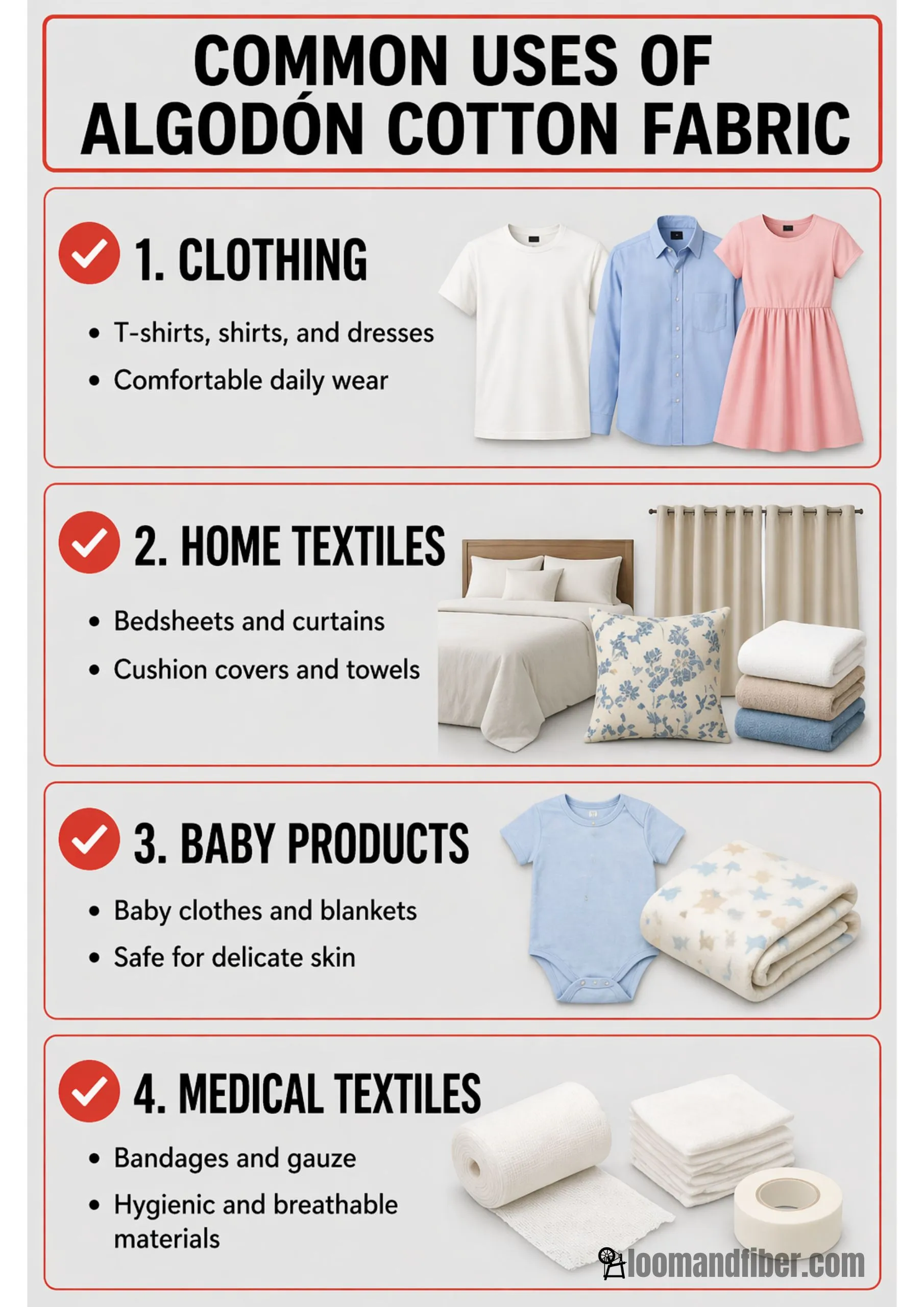
- Clothing: The majority of day-to-day clothes are made with algodon. Cotton is commonly used in T-shirts, dresses, shirts and underwear and jeans. The comfort and breathability of cotton make it a perfect choice of casual and children wear.
- Home Textiles: Algodon controls the home fabrics. Bedding (sheets, pillowcases), towels, washcloths and curtains are typically made of cotton. Algodon fabrics are also used in bedspreads, curtains and quilts due to the softness and durability.
- Baby Products: Due to its softness and hypoallergenic properties, Cotton is also the preferred material when it comes to baby clothes, blankets and bibs. Algodón is soft to the skin of the infants and it is a good moisture retention. It is due to this reason that parents tend to use 100% cotton clothes and swaddles to newborns.
- Medical Textiles: Cotton is commonly used in medical supplies. Cotton is used to make bandages, gauze, surgical masks and wound dressings since it is absorbent, sterile (when processed) and soft on the skin. The medical gauze and pads, as an example, are usually 100% algodon.
Advantages and Disadvantages of Algodón Cotton
- Advantages: Cotton is a natural and breathable fiber that can be comfortable in any climate. It is gentle and soft, so it is hypoallergenic and friendly to the skin. Cotton can be used in many different ways; organic algodon is an eco-friendly choice because it breaks down and can be cultivated without pesticides.
- Cons: Cotton is easily wrinkled on drying and normally requires ironing. It may shrink when washed or dried in high temperature. In addition, cotton is heavier and slower to dry compared to synthetic fabrics. Lastly, white algodon may fade or turn yellow with time when subjected to direct sun or chemicals.
Algodón vs Other Fabrics
Polyester vs Algodón
| Feature | Algodón | Polyester |
|---|---|---|
| Comfort | High | Medium |
| Durability | Medium | High |
| Breathable | Yes | No |
Algodón vs Linen
| Feature | Algodón | Linen |
|---|---|---|
| Softness | High | Medium |
| Cooling | Good | Excellent |
| Wrinkles | Medium | High |
Algodón vs Silk
| Feature | Algodón | Silk |
|---|---|---|
| Cost | Low | High |
| Feel | Soft | Very smooth |
| Care | Easy | Difficult |
How to Identify High-Quality Algodon Cotton
✔ Thread Count Myths
The number of threads does not necessarily indicate higher quality.
Pay attention to the quality of fiber.
✔ Fabric Feel Test
Thickness and smoothness is a sign of quality.
Do not use rough or hard cloth
✔ Label Reading Tips
Look for “100% algodón”
Blend percentage on checks.
✔ Certifications
Eco-friendly production is guaranteed by organic certifications.
OEKO-TEX certification ensures that harmful substances are within safe limits.
Care and Maintenance Tips
- Washing: machine-wash algodón in cold or in lukewarm water on gentle cycle to avoid shrinkage. Wash with a light detergent. The cotton fibers can be swollen and shrunk or fade when subjected to hot water.
- Drying: Do not dry at high temperatures. Air dry on a flat or tumble dry on low/medium. Cotton shrinkage is primarily caused by high dryer heat. The use of low-heat, or air-dry environment will allow preserving the size and softness of the fabric better.
- Ironing: Cotton wrinkles so that ironing might be required to ensure a sharp appearance. Iron on medium-hot using an iron and preferably when the fabric is a bit wet. Wet algodon should not be subjected to very high heat which can contract the fibers. A steam iron is nice, however, do not press a hot iron on wet cotton too long.
- Avoiding Shrinkage: In the case of clothing or fabrics that may shrink, purchase pre-shrunk clothes where possible. Should it be raw cotton cloth, wash and dry the cloth after which it should be cut. Overall, it is recommended to handle (no wringing) and care labels will ensure that algodon items do not appear much smaller than their true size.
Is Algodón Cotton Sustainable?
Algodon cotton has the potential to be sustainable when it is responsibly produced.
Organic farming does not use toxic substances. Hence, it conserves soil and water.
But cotton cultivation consumes a lot of water. This brings about environmental issues.
Consequently, alternative crops and more sustainable agricultural practices are becoming popular.
Conclusion-
You now know very well what is algodon cotton fabric. It is plain cotton called in Spanish markets.
It is soft, breathable and comfortable. Thus, it is still one of the leading fabrics around the globe.
Algodon can be a good choice in case you desire something comfortable and natural. Nevertheless, never make purchases without checking the quality.
To achieve improved performance, consider similar fabrics and compare them.
Read More>> What is Cotton Sateen Fabric?
FAQs
Yes. Algodon nothing more than the Spanish word cotton. An algodon on a label will indicate that the product is cotton.
When there is a label containing 100% algodón, it is 100% pure cotton fiber. Algodón itself simply translates to cotton, it may also have blends (e.g. algodón+polyéster) and therefore you should always make sure to look at the percentages on the label.
Absolutely. The ability of cotton to be breathable and wick moisture is ideal in warm weather. Algodon clothing also keeps the body cool; it allows air to pass through it and it absorbs sweat. It is usually the fabric of choice of hot weather clothes.
Yes, as all cotton, algodon may be shrunk when it is improperly washed or dried. Shrinkage occurs primarily when using hot water or high dryer heat. To reduce this, wash in cool water and dry on a low heat or dry by air. There are also pre-shrunk cotton fabrics.