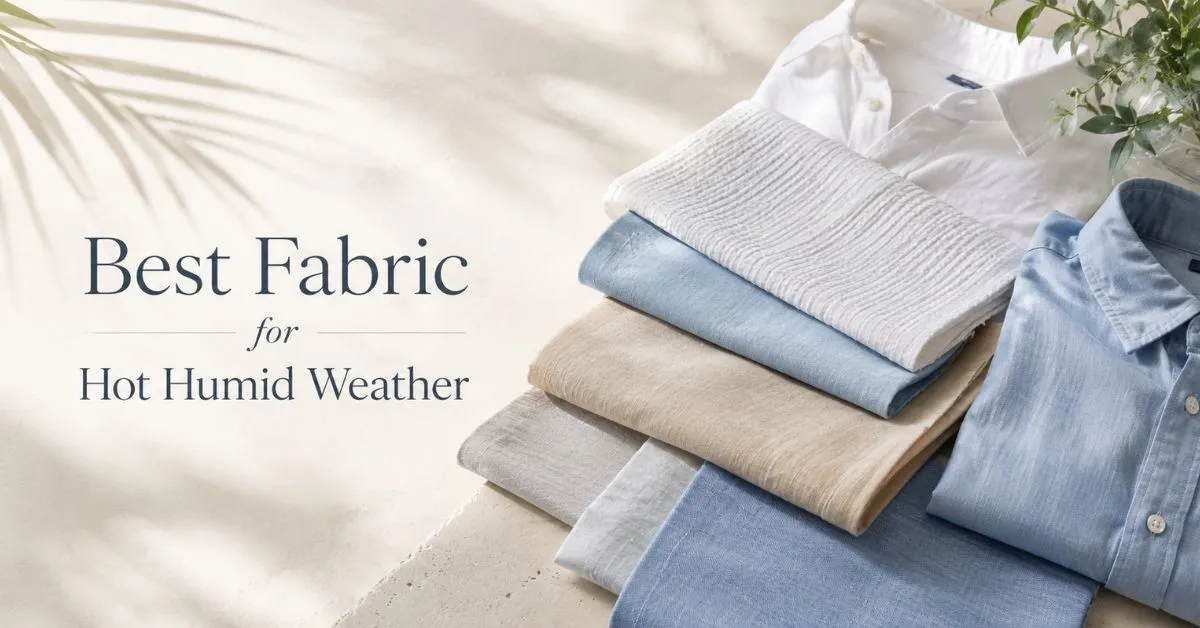

The best fabric for hot and humid weather is linen. It allows airflow, absorbs moisture, and tends to hang slightly away from the skin. Cotton voile, cotton lawn, chambray, seersucker, lyocell, bamboo viscose, and lightweight rayon are other good options. For athletic wear that dries faster than most natural fibers, consider moisture-wicking polyester, nylon, or merino blends.
Comfort decreases with increasing humidity because the primary means for the body to cool is through the evaporation of sweat. With high humidity, the evaporation of sweat is slowed and the body is more difficult to cool. Mayo Clinic notes that high humidity prevents sweat from evaporating as quickly, which reduces the body’s ability to cool itself and increases heat-related illness risk.
What Makes a Fabric Good for Hot and Humid Weather?
A fabric that feels comfortable in hot and humid weather should breathe, manage sweat, dry quickly, feel light against the skin, and resist clinging.
What makes the best fabric for hot and humid weather is not always a single fiber. It is a combination of fiber, weave, fabric weight, texture, fit, and drying speed. A good example is that a loose-fitting linen shirt will feel cooler than a cotton t-shirt that is fitted. Another good example is that cotton voile will feel cooler than heavy cotton jersey.
| Factor | Why it matters in humidity |
|---|
| Breathability | It allows air to pass through the fabric. |
| Moisture absorption | It absorbs sweat instead of leaving it on skin. |
| Moisture wicking | It moves sweat away from skin. |
| Drying speed | It prevents wet, heavy, sticky clothing. |
| Fabric weight | Lightweight fabric traps less heat. |
| Weave structure | Open weaves allow better airflow. |
| Surface texture | Textured fabric reduces skin contact. |
| Fit | Loose clothing improves air circulation. |
According to REI, lightweight woven fabrics often drape away from the body more than knits.
Best Fabrics for Hot Humid Weather Ranked
It’s tough to beat linen for humid heat. Lightweight cottons, seersucker, lyocell, bamboo viscose, rayon, merino, and moisture-wicking synthetics also have their place.
| Rank | Fabric | Best for | Main benefit | Main weakness |
| 1 | Linen | Shirts, pants, dresses, summer outfits | Excellent airflow and cooling feel | Wrinkles easily |
| 2 | Cotton voile/lawn | Daily wear, shirts, tops | Soft, breathable, skin-friendly | Holds sweat longer |
| 3 | Chambray | Summer shirts, casual wear | Lighter alternative to denim | Less airy than linen |
| 4 | Seersucker | Shirts, dresses, summer suits | Texture sits away from skin | Casual appearance |
| 5 | Lyocell/Tencel | Shirts, dresses, bedding, loungewear | Smooth feel and moisture control | Can be delicate |
| 6 | Bamboo viscose | T-shirts, underwear, sleepwear | Soft, breathable, comfortable | Often chemically processed |
| 7 | Rayon/viscose | Dresses, flowy tops | Lightweight and cool-to-touch | Can shrink or wrinkle |
| 8 | Lightweight merino wool | Travel, hiking, odor control | Breathable and odor-resistant | Expensive in quality weights |
| 9 | Moisture-wicking polyester blends | Sports, gym, travel | Fast drying and sweat-wicking | Can hold odor |
| 10 | Nylon blends | Activewear, outdoor clothing | Durable and quick-drying | Can trap heat when dense |
According to Georgia Tech, textile expert Sundaresan Jayaraman says linen is the best fabric for hot and humid weather. He points to linen’s moisture management, airflow, and lower tendency to cling.
Linen: Best Fabric for Hot Humid Weather
In what way is linen the best fabric for hot humid weather?
It generally breathes better than cotton, manages moisture well, dries faster than cotton, and is less likely to cling.
Linen is made from flax fiber. It often has a crisp hand and, in lightweight open-weave constructions, an airy structure that also helps the fabric breathe and helps aid moisture transfer. According to Georgia Tech, linen wicks moisture better than both polyester and cotton.
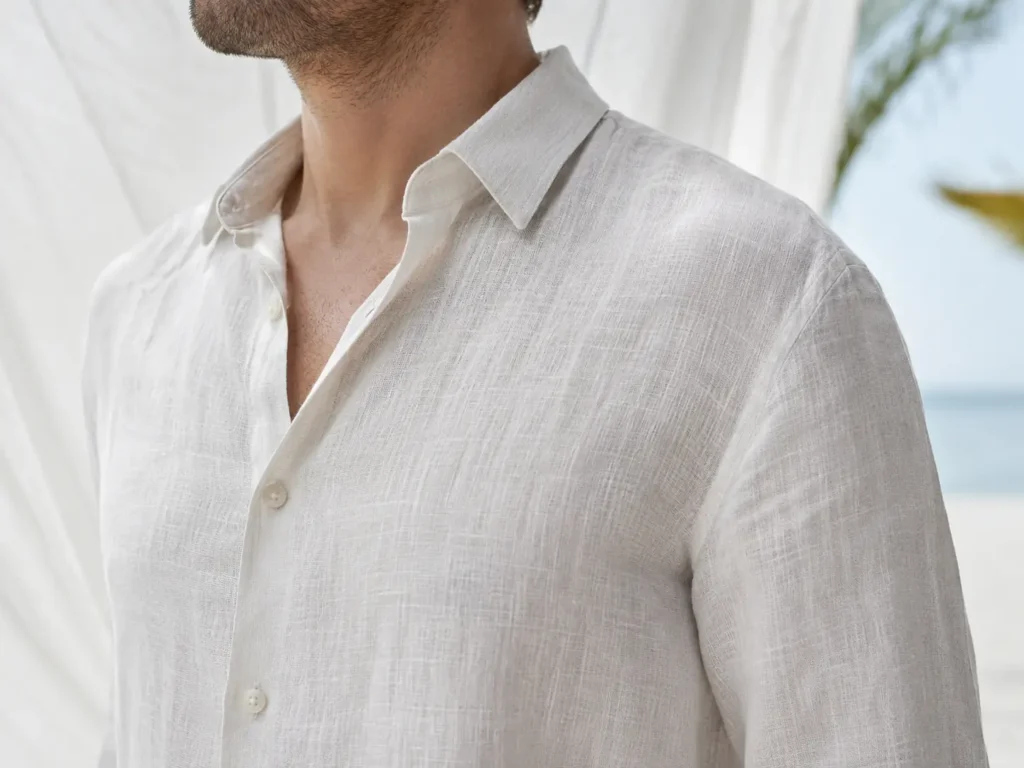
- Best use: Summer outfits, shirts, trousers, dresses, and resort wear. Loose overshirts.
- Why it works: Linen has excellent airflow, moisture absorption, and low cling.
- When to avoid it: Heavy linen canvas can feel stiff and dense, especially in extreme humidity.
- Best garments: Linen shirts, dresses, shorts, and pants, and linen-blend office shirts.
- Pros: Elegant, breathable, naturally cool, and durable.
- Cons: Crisp hand, wrinkles easily, and may require careful finishing or pressing.
Cotton Voile and Cotton Lawn: Best Soft Daily Fabrics
Is cotton good for hot humid weather?
It can be, but only if the cotton is lightweight, woven, and loose. For example, cotton voile and cotton lawn are better than heavy cotton jersey.
Cotton is soft with a familiar feel. But since it absorbs moisture, it can feel damp after long exposure. REI says that lightweight cotton can work in humidity if it drapes well.
- Best use: Daily shirts and blouses, modest wear, children’s clothing, and summer tops.
- Why it works: Voile and lawn are fine, light, and breathable.
- When to avoid it: During heavy sweating, avoid thick cotton jersey.
- Best garments: Cotton voile shirts, cotton lawn tops, cotton summer dresses, and loose tunics.
- Pros: Soft, breathable, affordable, skin-friendly.
- Cons: Holds sweat longer than linen and many performance synthetics.
Chambray: Best Denim Alternative for Humid Weather
Is chambray good for hot humid weather?
Yes, chambray is a good option because it is light and offers a denim-like look, but with better airflow.
Chambray is generally a plain-weave cotton fabric. It is similar to denim, but much lighter. It is perfect for those who want a casual blue shirt, but dislike heavy denim.
- Best use: Casual shirts, shirt dresses, light overshirts, and summer uniforms.
- Why it works: It gives you structure, but without the density of denim.
- When to avoid it: Avoid heavy chambray during peak tropical heat.
- Best garments: Chambray shirts, chambray dresses, and lightweight casual tops.
- Pros: Casual, breathable, durable, and easy to style.
- Cons: Less cooling than linen or voile.
Seersucker: Best Textured Fabric for Humid Weather
How can seersucker work in humid weather?
Seersucker works in humid weather because its puckered texture minimizes the amount of fabric that comes in contact with the skin and promotes airflow.
Seersucker has a puckered, crinkled surface that reduces how much fabric lies flat against the skin. Because of this, it does not feel sticky when compared to other tight, smooth fabrics.
REI recommends the use of textured fabrics in humid weather because they help lift the fabric away from the skin.
- Best use: Summer shirts, casual suits, and dresses, and even school uniforms and office wear.
- Why it works: It creates small air gaps.
- When to avoid it: Very formal dress codes.
- Best garments: Seersucker dresses, seersucker suits, seersucker shirts, and lightweight shorts.
- Pros: Airy, sweat-friendly, and wrinkle-friendly classic.
- Cons: Casual look, might not suit every setting.
Lyocell and TENCEL™ Lyocell: Best Smooth Fabric for Humid Weather
Is lyocell good for hot humid weather?
Lyocell is good for hot humid weather because it is smooth, controls moisture, and helps keep the skin microclimate drier.
Lyocell is a regenerated cellulose fiber. TENCEL™ Lyocell is Lenzing’s branded lyocell fiber, known for moisture absorption and release that can help support a drier skin microclimate.
- Best use: Shirts, dresses, loungewear, sleepwear, and even sheets.
- Why it works: It has a smooth, cool, and moisture-dynamic feel.
- When to avoid it: Avoid delicate lyocell fabrics for rugged outdoor use unless they are blended or engineered for durability.
- Best garments: Lyocell and Tencel shirts, dresses, and pants, and sleepwear.
- Pros: Good for sensitive skin, lightweight, and breathable.
- Cons: May wrinkle, shrink, or lose durability depending on fabric construction and care.
Bamboo Viscose: Soft Fabric for Underwear and Sleepwear
Is bamboo fabric suitable for hot weather?
Bamboo viscose can feel cool and soft, although most products marketed as bamboo fabric are actually rayon or viscose made from bamboo pulp.
A lot of brands will call a fabric “bamboo,” but in the end, the fabric is usually rayon or viscose made from bamboo pulp. Good Housekeeping notes that there are many bamboo sheets which are rayon from bamboo and not bamboo fabric.
- Best use: Soft loungewear, baby wear, T-shirts, sleepwear, and underwear.
- Why it works: Light and cool on the skin.
- When to avoid: Avoid bamboo with no details on the fiber.
- Best garments: Bamboo viscose pajamas, modal blends, soft tees.
- Pros: Smooth, soft, and comfortable.
- Cons: Depending on production, processing may be chemical-heavy.
Rayon/Viscose: Best Fabric for Flowy Summer Dresses
Is rayon good for humid weather?
Rayon is good for humid weather because it drapes well in loose, flowy garments.
Dresses and wide-leg garments can be made of rayon and Viscose. Keep in mind though that these can easily wrinkle, shrink, and lose strength when wet. This is why quality and care instructions are important.
REI groups rayon, viscose, and lyocell as plant-based but highly processed fabrics whose properties vary widely. Depending on how rayon is constructed, it can also be very breathable and quick to dry.
- Best use: Flowy tops, summer blouses, skirts, and dresses.
- Why it works: It drapes away from the body.
- When to avoid it: Tight rayon clothes + heavy sweating = bad combination.
- Best garments: Rayon dresses, viscose blouses, wide-leg pants, printed tops.
- Pros: Cool, flowy, lightweight, and flattering.
- Cons: Wrinkles easily and may shrink in the wash.
Lightweight Merino Wool: Best for Travel and Odor Control
Is merino wool good for hot humid weather?
Yes, lightweight merino can work in humid weather because it wicks moisture and breathes, plus it is odor-resistant.
It may sound strange for summer. However, lightweight merino performs much differently than thick winter wool. According to REI, merino wool breathes, wicks moisture, and controls odor better than many synthetic options.
- Best use: Travel, hiking, long walks, socks, underwear, and base layers.
- Why it works: Great for repeated wear and managing odor.
- When to avoid it: Avoid thick merino in tropical heat.
- Best garments: Merino tees, socks, underwear, and travel polos.
- Pros: Odor resistant, breathable, and soft in fine grades.
- Cons: Costly and generally less durable than nylon or polyester.
Moisture-Wicking Polyester Blends: Best for Exercise
Is polyester good for hot humid weather?
Only for workouts, and only if it is engineered to be wicking and quick drying.
Basic polyester can feel hot, sticky, and less breathable. Performance polyester, however, wicks moisture and dries quickly. According to REI, moisture-wicking means that sweat moves from the body and is quickly dried on the outer surface of the fabric.
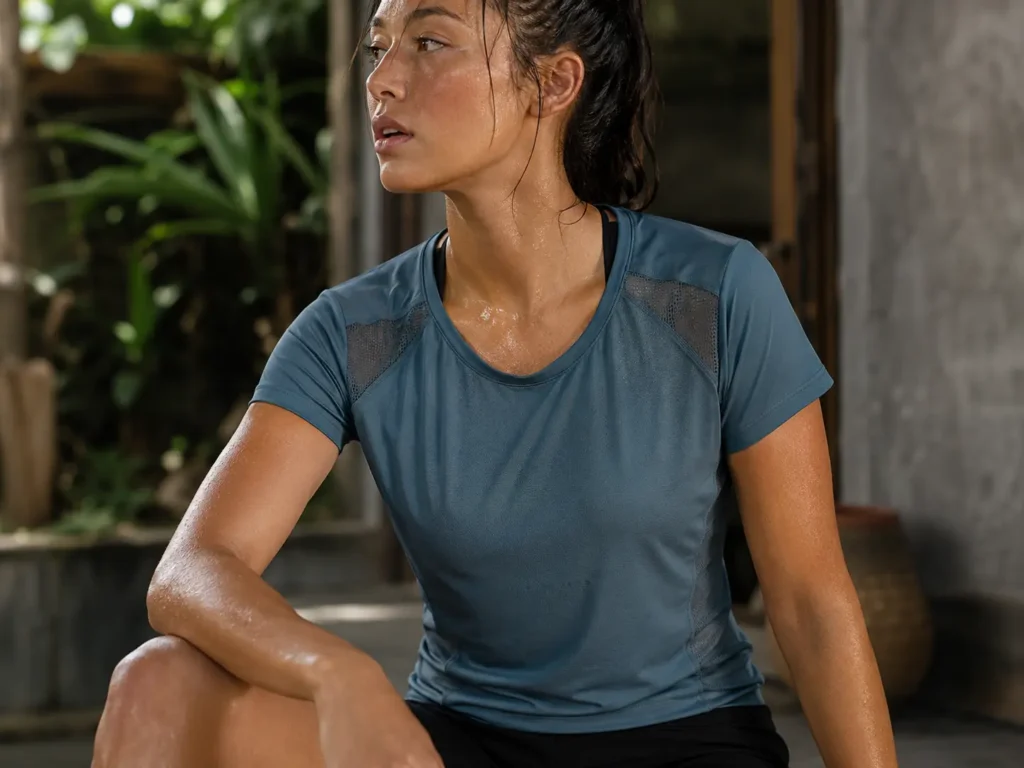
- Best use: Gym wear, running shirts, travel tees, sports uniforms, and tops for hiking.
- Why it works: It dries quickly after heavy sweating.
- When to avoid it: Avoid low-quality, dense polyester for everyday humid conditions.
- Best garments: Wicking tees, mesh polos, sports shorts, and performance base layers.
- Pros: Fast-drying, durable, lightweight, and easy to care for.
- Cons: May retain odor and feel less natural than cotton or linen.
- Read More>> Can you Dry Clean Polyester?
Nylon Blends: Best for Outdoor Durability
Is nylon good for hot humid weather?
Good for activewear if light, breathable, and stretchy.
Nylon dries fast and is resistant to wear and tear. Great for travel pants, hiking shorts, and outdoor shirts. Tightly woven nylon can trap heat, so construction is more important than fiber name alone.
REI suggests base layers in polyester, nylon, or merino wool as they wick and dry.
- Best use: Hiking, travel, activewear, outdoor pants, quick-dry shirts.
- Why it works: Strength, stretch, and quick drying.
- When to avoid it: Avoid dense nylon, especially without vents or mesh.
- Best garments: Nylon travel pants, hiking shirts, shorts, and stretch trousers.
- Cons: Dense, tightly woven nylon can feel warm.
Linen vs Cotton: Which Is Better for Hot Humid Weather?
Linen breathes, dries faster, and is less clingy. Cotton is typically regarded as the gentler, more comfortable, more convenient option for everyday wear. However, cotton retains moisture longer, ultimately leaving the fabric feeling heavy and saturated. Compared with cotton, linen is cooler, airier, and less sticky.
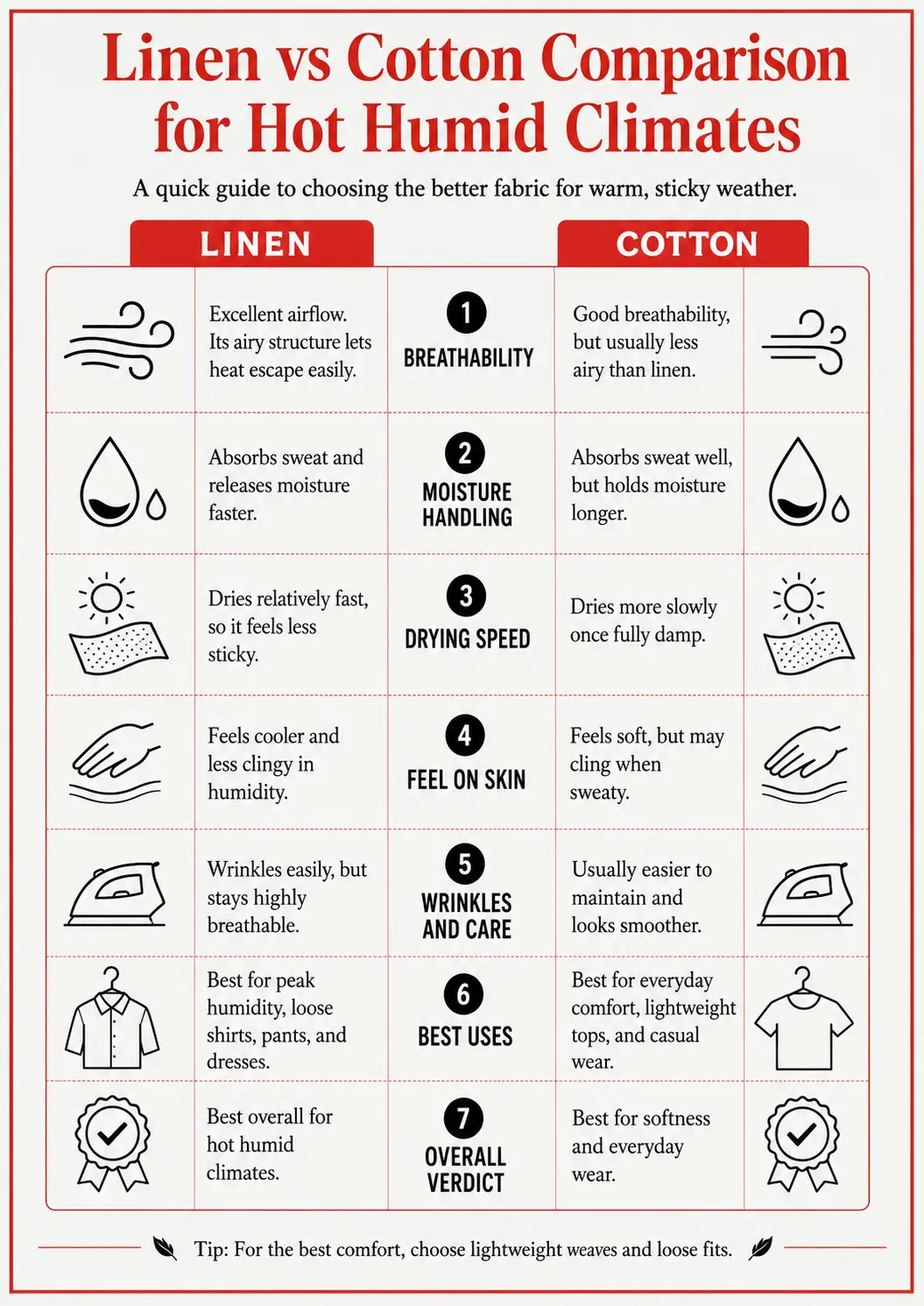
According to Georgia Tech, linen has an advantage over cotton in its moisture vapor transport, and unlike linen, cotton can feel clammy in the extreme heat.
| Feature | Linen | Cotton |
| Breathability | Excellent | Good to excellent |
| Sweat absorption | Good | Good |
| Drying feel | Faster and airier | Slower when wet |
| Cling | Lower | Higher in knits |
| Softness | Crisp, softens over time | Soft from first wear |
| Wrinkles | Wrinkles easily | Wrinkles less than linen |
| Best use | Peak humidity | Daily comfort |
Best Cotton Fabrics for Hot Humid Weather
What cotton fabric is best for hot, humid weather?
The best cotton options for humid heat are cotton voile, cotton lawn, cotton gauze, and cotton poplin.
Do not judge cotton as one fabric. For example, cotton voile is airy, while cotton fleece is hot. Additionally, cotton lawn is smooth and light and cotton canvas is dense. For sleepwear and bedding, cotton percale can be helpful because its weave is light and airy, although cotton can still hold moisture.
| Cotton type | Good for humidity? | Why |
| Cotton voile | Excellent | Very light and airy |
| Cotton lawn | Excellent | Smooth, fine, breathable |
| Cotton poplin | Good | Crisp and lightweight |
| Cotton gauze | Excellent | Open and breathable |
| Muslin | Good | Lightweight and casual |
| Chambray | Good | Better summer denim alternative |
| Cotton jersey | Average | Soft but may cling |
| Heavy cotton canvas | Poor | Too dense and heavy |
Fabric Weave Matters More Than Fabric Name
Does weave matter in hot humid weather?
Yes, weave can matter more than fiber, as it can impact airflow, cling, texture, and drying behavior.
Cotton jersey fabric can feel hot and heavy while cotton voile can feel light and breezy. The same guidelines can apply to linen, as very lightweight linen shirting can feel cooler than heavy linen canvas.
According to REI, breathability can be impacted by a fabric’s weave, particularly a fabric’s knit or weave. Generally speaking, open weaves, thinner fabrics, and fine yarns tend to be more breathable.
| Weave or fabric structure | Humidity performance | Best use |
| Voile | Excellent | Shirts, blouses, summer tops |
| Lawn | Excellent | Shirts, dresses, soft tops |
| Gauze | Excellent | Casual wear, babywear, beachwear |
| Poplin | Good | Office shirts, uniforms |
| Seersucker | Excellent | Shirts, suits, dresses |
| Chambray | Good | Casual shirts, summer denim look |
| Percale | Good | Sleepwear and bedding |
| Jersey | Average | T-shirts and underwear |
| Twill | Average to poor | Chinos, uniforms |
| Canvas | Poor | Workwear and bags |
Professional insight: Fabric construction often makes the biggest difference in humid conditions. For example, a shirt that is slightly loose and woven is often better than a tightly knit shirt that is deemed “breathable.”
What is the best fabric for hot humid weather by type of clothing?
For daily clothing, opt for airy woven fabrics. For more physically demanding activities, go for wicking fabrics.
| Clothing item | Best fabric choices |
| Shirts | Linen, cotton voile, cotton lawn, chambray, lyocell |
| T-shirts | Lightweight cotton, bamboo viscose, lyocell, merino blend |
| Pants | Linen, cotton-linen blend, chambray, rayon blend |
| Dresses | Linen, rayon, viscose, cotton lawn, lyocell |
| Underwear | Bamboo viscose, modal, micromodal, wicking blends |
| Office wear | Cotton poplin, linen blend, tropical wool, seersucker |
| Travel clothes | Merino wool, lyocell, nylon blend, polyester blend |
| Sleepwear | Cotton percale, bamboo viscose, lyocell, lightweight modal |
| Workout clothes | Polyester blends, nylon blends, merino blends |
Office clothing should combine structure and airflow as well. Linen blends usually wrinkle less than 100% linen. Cotton poplin looks sharper than cotton gauze.
For sleep, choose smooth fabrics that manage moisture without feeling rough or clingy. Good options include lyocell, bamboo viscose, modal, and cotton percale.
What is the best fabric for hot humid weather by type of activity?
Linen is great for most activities in the heat, casual or otherwise. For more physically demanding activities, go for wicking fabrics.
| Activity | Best fabrics | Why |
| Everyday wear | Linen, cotton lawn, cotton voile | Breathable and comfortable |
| Office wear | Cotton poplin, linen blend, seersucker | Crisp but airy |
| Walking | Lyocell, linen, merino blend | Breathable and less sticky |
| Travel | Merino, lyocell, nylon blend | Odor control and easy care |
| Gym | Polyester or nylon blends | Fast drying and sweat-wicking |
| Sleeping | Cotton percale, lyocell, bamboo viscose | Smooth and breathable |
| Sensitive skin | Cotton, lyocell, bamboo viscose | Soft and gentle |
| Sweat odor | Merino, lyocell, treated synthetics | Better odor control |
According to REI, wicking fabrics draw moisture to the outer layer of the fabric. This is why activewear is more beneficial than cotton during heavy sweating.
What are the worst fabrics for hot humid weather?
Heavy, tight, coated, dense, and non-breathable fabrics should be avoided.
Some basic synthetics can trap heat, but engineered sport polyesters can work well when they are breathable, moisture-wicking, and quick-drying. A few natural fabrics aren’t that great either, like thick cotton, corduroy, or heavy denim.
| Fabric | Why it can feel uncomfortable |
| Non-wicking polyester | Can trap heat and feel sticky |
| Tightly woven nylon | Durable but may reduce airflow |
| Acrylic | Often warm and less breathable |
| Heavy denim | Dense, slow-drying, heat-trapping |
| Leather | Blocks airflow |
| Corduroy | Thick and heat-retaining |
| Fleece | Designed for warmth |
| Polyester satin | Smooth but often clingy |
| Heavy wool | Too insulating in humid heat |
| Coated fabrics | Reduce air exchange |
Some engineered polyesters can be useful in a workout setting. Basic polyesters, however, are not ideal for humid weather.
How to Choose the Best Fabric for Hot Humid Weather
Match the fabric to the activity, the sweat level, the dress code, and your skin sensitivity.
Use this simple formula:
For the best airflow, select linen. Choose cotton voile or cotton lawn for a soft, lightweight fabric. Lyocell or bamboo viscose gives you a smooth, soft fabric. Merino is great for travel since it has odor control. For moisture-wicking fabric, select polyester or nylon, but leave the heavy, tight, coated, and non-breathable fabrics at home.
| Need | Best choice |
| Maximum cooling | Linen |
| Soft daily comfort | Cotton lawn or voile |
| Office polish | Cotton poplin or linen blend |
| Smooth skin feel | Lyocell or bamboo viscose |
| Travel odor control | Lightweight merino |
| Heavy sweating | Wicking polyester or nylon |
| Summer dresses | Linen, rayon, viscose, lyocell |
| Humid sleep | Cotton percale, lyocell, bamboo viscose |
The Mayo Clinic recommends loose, lightweight clothing in the heat since tighter clothing sticks and traps moisture.
Common Mistakes When Choosing Summer Fabrics
Common mistakes include choosing dense fabrics, poor weaves, and clothing that does not match the activity.
Mistake 1: Choosing cotton jersey since it looks soft
Cotton jersey can feel sticky and sweaty in humid weather, so a better option would be cotton voile, cotton lawn, poplin, gauze, or chambray.
Mistake 2: Tight clothing in humid weather
Tight clothing can trap moisture against the skin. The Mayo Clinic recommends loose clothing since it is more cooling.
Mistake 3: Selecting a dark color for hot, sunny days
Dark colors absorb heat and therefore light colors like white, tan, beige, light blue, and khaki are cooler.
Mistake 4: Choosing dense fabric like heavy denim
Dense, slow-drying fabrics like heavy denim should be left at home, and great options are lightweight cotton-linen trousers or chambray.
Mistake 5: Thinking natural fabrics are all cool
Just because a fabric is natural does not mean it is breathable. Thick wool, canvas, and heavy silk can feel hot.
Mistake 6: Thinking all synthetics are bad
Synthetics are not all bad. Performance nylon and polyester fabrics can be suitable for exercise if they are breathable, wicking, or quick-drying.
Mistake 7: Not Considering GSM and Weight
Weight is also a factor in comfort. For instance, 110 GSM cotton is cooler than 240 GSM cotton jersey.
Mistake 8: Not Considering Finishes
Breathability can also be compromised by a wrinkle-free finish or coatings and dense linings. Always check the full fabric content.
Quick Decision Guide: Best Fabric for Hot Humid Weather
Question: What is the quickest way to choose the right fabric?
Choose the fabric by the sweat level first, then the weave and fit.
| Situation | Best answer |
| Hot, humid city day | Linen shirt and loose cotton trousers |
| Tropical vacation | Linen, rayon, cotton gauze, lyocell |
| Humid office | Cotton poplin, linen blend, seersucker |
| Outdoor walking | Lyocell, merino blend, nylon blend |
| Gym workout | Wicking polyester or nylon |
| Summer wedding guest | Linen blend, rayon, viscose, lightweight silk blend |
| Sensitive skin | Cotton lawn, lyocell, bamboo viscose |
| Heavy sweat odor | Merino, lyocell, antimicrobial-treated synthetics |
| Casual denim look | Chambray instead of denim |
| Hot sleeping | Cotton percale, lyocell, bamboo viscose |
Read More>> What to wear vs what to avoid in Hot Humid Weather.
Conclusion-
Linen is best for hot and humid weather because it is cool and breathable. But cotton lawn, cotton voile, lyocell, and bamboo viscose can be better for day-to-day wear. For exercise, consider moisture-wicking fabrics or blends made with polyester, nylon, or lightweight merino.
Three rules help create the best humid-weather outfit. The first rule creates the foundation: pick lightweight fabrics. The second rule addresses fabric surface. Choose a fabric with an open weave or a textured surface. Lastly, choose a fit that allows air to circulate around the body.
Read More>> Breathable Fabric for Summer Bedsheets.
FAQ: Best Fabric for Hot Humid Weather
The best fabric for hot humid weather is linen. It is one of the most breathable options and allows for sweat absorption while standing away from the body. Other great options are cotton voile, cotton lawn, seersucker, chambray, lyocell and bamboo viscose. For the best fabric options to exercise in, go for moisture-wicking polyester, nylon, or merino blends.
In most cases, yes, linen is better than cotton in humid weather. Linen breathes better and dries faster while also not clinging to the body. Cotton also can absorb moisture but stays wet for longer. So, for humid weather, lightweight cotton in the forms of loosely woven voile, lawn, poplin, and gauze are best.
Cotton is a good option for hot and humid weather if the cotton is light and loose. Fabrics such as cotton gauze, poplin, and cotton voile are better for hot weather than thicker cotton fabrics such as cotton jersey. It does wick away moisture, but since it also has high absorbency, it does not dry as quickly as synthetic fabrics such as polyester or nylon, or other fabrics such as linen.
Polyester fabrics can be considered good fabrics for hot and humid weather, but only if they are designed to be moisture-wicking and breathable. Performance polyester fabrics are great for hot and humid weather as they move moisture away quickly and dry rapidly. Standard polyester fabrics can heat up and become sticky. They also trap moisture and odor when worn.
Rayon fabric can be considered good for humid weather, especially if it is designed to be loose and flowy. Rayon feels light and cool to the touch. However, rayon can easily be damaged when wet, and can be insubstantial for some applications. Because of this, rayon is a better option for dresses and tops than activewear.
Bamboo fabric can be good for hot weather because it is soft, smooth, and cool to the touch. It can also be good for hot weather because it can be used for designing fabrics for underwear, sleepwear, or even t-shirts. However, most of what is marketed as bamboo fabric is actually rayon, viscose, modal, or lyocell made from bamboo-derived cellulose.
Lyocell can definitely be considered better than cotton during summer months. Lyocell can better help achieve a drier skin feel during the hot and humid months, and also manage moisture better than cotton. However, it is important to consider that cotton can be designed to be crisper and provide better support than lyocell, and also be better for casual wear.
Cotton, linen, rayon, viscose, bamboo viscose, and lyocell can all absorb sweat well. One thing to keep in mind is that just because a fabric absorbs sweat does not mean it will dry quickly. While cotton will absorb sweat, it may stay damp. However, linen and lyocell often feel drier, since they manage moisture a little more effectively.
The fastest-drying materials in humidity are usually moisture-wicking polyester or nylon fabrics. Drying well in humidity can also be lightweight merino. Linen will generally dry faster than cotton, but still will not dry as fast as a lot of other synthetic performance fabrics. Because of this, moisture-wicking synthetics are often the best choice for gym clothing.
Heavier fabrics will all be a poor choice. These include everything from denim to leather to fleece, corduroy, and dense fabrics. These fabrics can trap heat, cling to sweaty skin, and feel uncomfortable in humid weather. However, for sport and travel lightweight synthetic performance fabrics can still be a good choice.
Heavy sweating is usually best managed by moisture-wicking fabrics such as polyester, nylon, or lightweight merino wool. Casual sweating can be managed with breathable, loose fabrics such as linen, cotton voile, cotton lawn, chambray, or lyocell.
The best summer dress fabrics are linen, cotton gauze, rayon/viscose, and lyocell. Linen is one of the most breathable options. Rayon/viscose has excellent drape. Cotton gauze is soft, airy, and lightly textured.
The best fabrics for humid office wear are linen blends, tropical wool, lyocell, cotton poplin, and seersucker. Cotton poplin has a crisp, professional look. Linen blends offer strong breathability, and seersucker improves airflow through its puckered texture. While seersucker is more casual, lyocell can look smooth and polished for office wear.
The best fabrics for a tropical climate are linen, cotton gauze, cotton lawn, seersucker, chambray, lyocell, bamboo viscose, and rayon/viscose. All can be breathable when lightweight, loose-fitting, and made with airflow-friendly construction. Heavy knits, tight weaves, and heavy fabrics are best avoided.
The best fabrics for hot weather and sensitive skin are lightweight modal, lyocell, bamboo viscose, cotton voile, and cotton lawn. These gentle fabrics usually cause less irritation and friction. Avoid tight, heavy, and scratchy fabrics.